A rubber hose connection may look like a simple assembly, but its reliability depends on several details working together. The hose must fit the connecting pipe correctly, the clamp must apply pressure in the right position, and the sealing surface must remain stable under operating conditions. If any of these factors are overlooked, the connection may develop fluid leakage, air loss, hose slippage, or premature material damage.
For automotive systems, industrial equipment, and fluid transfer applications, rubber hose connection design should be considered during the product development stage rather than treated as a final installation step. This guide explains how to position hose clamps, improve joint sealing, select suitable connection structures, and reduce common leakage risks.
A rubber hose connects two components while accommodating movement, vibration, pressure changes, and temperature fluctuations. Unlike rigid metal pipes, rubber hoses can deform under external compression and internal pressure. This flexibility makes them useful in automotive cooling systems, fuel delivery assemblies, air intake systems, and industrial machinery.
However, the same flexibility also creates potential sealing challenges. An incorrectly matched hose diameter may leave insufficient contact pressure, while excessive clamp force can deform the hose wall. Poor alignment can introduce uneven loading, and continuous vibration may gradually loosen an otherwise acceptable connection.
A reliable hose connection therefore needs to achieve three basic objectives:
These requirements should be evaluated together. Increasing clamp force alone does not necessarily improve sealing if the hose material, fitting geometry, or connection dimensions are unsuitable.
Clamp positioning directly affects how compression is distributed around the hose circumference. A clamp placed too close to the hose end may provide inadequate retention, while one positioned over an unsuitable section of the fitting may create localized deformation or leakage paths.
For a conventional hose-and-barb connection, the clamp should generally sit over the portion of the hose that covers the fitting's sealing and retention area. It should not hang beyond the hose end or sit on a section without proper support from the fitting.
The exact position depends on the fitting design, hose insertion depth, clamp type, and manufacturer's installation requirements. Where the fitting has a raised bead or barb, the connection geometry should be considered when determining the final clamp location.
Before tightening, check that:
A hose clamp needs to distribute pressure evenly around the connection. If the clamp is tilted, incorrectly sized, or tightened unevenly, one section may experience excessive compression while another remains insufficiently sealed.
This is particularly important for soft rubber hoses and thin-wall constructions. Localized compression can leave permanent deformation, weaken the hose wall, or create a path for fluid or air to escape.
For production assemblies, the clamp type, nominal diameter, tightening method, and installation position should be standardized. Where applicable, use the clamp manufacturer's recommended tightening torque or installation specification rather than relying on visual judgment alone.
Effective rubber hose joint sealing depends on more than the clamp itself. The hose inner diameter, fitting outer diameter, insertion length, surface condition, and rubber properties all influence the final sealing interface.
The hose inner diameter must be compatible with the fitting outer diameter. If the hose is too large, it may not develop adequate contact pressure even after tightening. If it is too small, installation can become difficult and may cause excessive stretching or damage.
Designers should consider dimensional tolerances on both components instead of relying only on nominal dimensions. Hose expansion, material hardness, wall thickness, and temperature-related dimensional changes can also affect the assembled connection.
For custom applications, it is useful to provide the hose manufacturer with the fitting dimensions, operating conditions, and assembly requirements before confirming the hose design.
Rubber material selection has a direct influence on sealing stability. Different elastomers respond differently to fuels, oils, coolants, water, air, heat, and environmental exposure.
There is no single rubber material suitable for every hose connection. The correct choice should be based on the actual fluid, temperature range, pressure, and expected service life.
Fuste Rubber provides customized extruded and formed rubber hose solutions using materials such as EPDM, NBR, silicone, CSM, and FKM. Explore the extrusion rubber hose product range to learn more about available hose applications and configurations.
The hose end should be clean, properly cut, and free from cracks, burrs, or visible damage. A rough or uneven hose end can interfere with proper insertion and create inconsistent contact around the fitting.
Likewise, the fitting surface should be free from contamination, corrosion, and sharp edges that could damage the inner rubber layer during assembly. For repeated production, controlling hose-end dimensions and fitting surface quality helps reduce assembly variation.
Different clamp designs provide different levels of adjustability, circumferential compression, and resistance to vibration. The best choice depends on hose construction, fitting geometry, operating pressure, temperature changes, and maintenance requirements.
Worm drive clamps use a screw mechanism to adjust the band diameter. They are widely used in general hose assemblies because they are relatively easy to install and adjust.
However, the band and housing design should be compatible with the hose. A narrow or poorly matched clamp may create concentrated pressure, particularly on soft rubber materials. Installation torque should follow the relevant manufacturer's specifications.
Spring clamps use elastic force to maintain pressure around the hose. They can be useful in applications involving temperature-related dimensional changes, such as automotive cooling systems.
The clamp's working range, material properties, and force characteristics should be evaluated against the hose dimensions and operating conditions. A spring clamp should not be selected simply because it can accommodate a range of diameters.
Constant-tension clamp designs are intended to maintain more consistent clamping force as the hose expands and contracts. They may be appropriate for applications with significant temperature cycling or dimensional changes.
Selection still requires checking the clamp's operating range, compatibility with the hose material, and the connection's pressure and vibration requirements.
When a hose assembly leaks, replacing the clamp is not always the correct solution. The underlying cause may involve dimensional mismatch, material degradation, poor installation, or an unsuitable connection structure.
| Common Problem | Possible Cause | Recommended Action |
|---|---|---|
| Leakage around the joint | Incorrect hose-to-fitting dimensions or insufficient compression | Check dimensional compatibility and clamp position |
| Hose slipping off | Insufficient insertion depth or inadequate retention | Review fitting geometry, insertion depth, and clamp selection |
| Cracks near the connection | Excessive compression, bending stress, or material incompatibility | Review material grade, clamp force, and hose routing |
| Repeated leakage after operation | Thermal cycling, vibration, or compression relaxation | Evaluate the complete assembly under operating conditions |
| Hose wall deformation | Excessive clamp force or unsuitable clamp geometry | Check tightening specifications and clamp compatibility |
For example, a coolant hose that repeatedly leaks near the radiator connection may have a dimensional mismatch or an unsuitable clamp position. Simply tightening the clamp further could damage the hose without solving the original problem.
In automotive cooling applications, the hose construction itself also matters. Fuste Rubber's customized EPDM radiator rubber hose is designed for coolant transfer between engine and radiator components, with a connection structure that can be evaluated alongside the selected clamp and fitting.
A reliable connection design should be verified through a consistent assembly and inspection process. This is particularly important for automotive OEM components and industrial equipment produced in batches.
Measure the hose inner diameter, outer diameter, wall thickness, fitting dimensions, and insertion depth. Confirm that the selected clamp can accommodate the assembled connection without excessive compression.
After installation, check that the hose is fully seated, the clamp is correctly positioned, and the hose wall has no visible cuts, folds, or localized damage. Confirm that the hose is not under unnecessary tension or bending stress.
Testing should reflect the actual working conditions. Depending on the application, verification may include pressure testing, vacuum testing, thermal cycling, vibration testing, or fluid compatibility evaluation.
For pressurized assemblies, the test pressure, duration, temperature, and acceptance criteria should be defined by the applicable engineering specification. Never assume that passing a static leak test automatically guarantees long-term performance under vibration or temperature cycling.
For critical systems, inspect connections after initial operation and during scheduled maintenance. Look for fluid residue, clamp displacement, rubber swelling, cracks, and signs of hose deformation.
Any retightening procedure should follow the clamp manufacturer's instructions and the assembly specification. Repeatedly tightening a damaged or incompatible hose connection is not a reliable leakage prevention strategy.
Connection reliability starts with the right hose design. Hose dimensions, rubber compound, reinforcement structure, end geometry, and clamp compatibility should be considered together, especially when developing components for automotive and industrial applications.
Fuste Rubber offers customized rubber hose manufacturing based on customer drawings, samples, and application requirements. Its product range includes extruded rubber hoses, formed hoses, reinforced silicone hoses, fuel hoses, and radiator hoses.
For projects requiring a pre-configured hose and clamp assembly, the small rubber hose product is a relevant example. The listed product supports custom sizing, with a stated size range of 4–55 mm and material options including FKM, ECO, and aramid-related constructions. Final material and dimensional specifications should be confirmed according to the application.
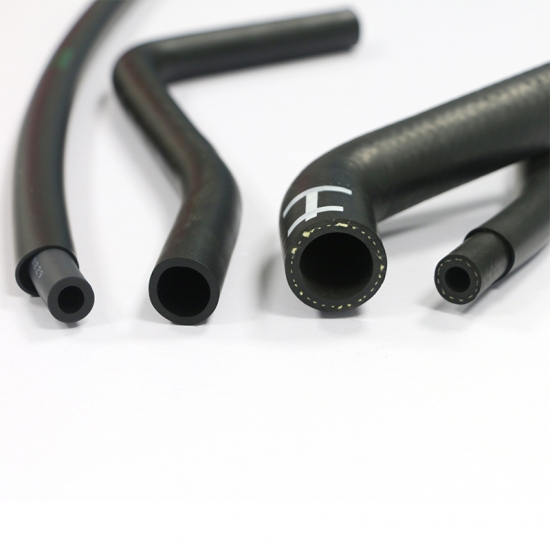
When requesting a customized hose, buyers can provide the following information to help the manufacturer evaluate the design:
By evaluating the hose and its connection as one assembly, manufacturers and buyers can identify potential sealing issues earlier, reduce installation variations, and develop a more reliable product for its intended operating environment.
A hose clamp should generally be positioned over the hose section that covers the fitting's sealing and retention area. It should not extend beyond the hose end or sit on an unsupported section. The final position depends on the fitting design and clamp manufacturer's installation instructions.
Yes. Excessive tightening can deform the rubber hose, damage its wall, or create uneven compression. These conditions may reduce sealing reliability and cause leakage over time. Always follow the specified installation torque or tightening procedure.
Common causes include incorrect hose and fitting dimensions, poor clamp positioning, insufficient or excessive compression, damaged hose ends, material incompatibility, and vibration or temperature-related dimensional changes.
There is no universal best material. EPDM is commonly used for coolant and water applications, NBR for many oil and fuel applications, silicone for selected high-temperature applications, and FKM for demanding heat and chemical environments. The correct compound depends on the fluid, temperature, pressure, and service conditions.
Use compatible hose and fitting dimensions, ensure sufficient insertion depth, select a suitable clamp, and position it over the supported connection area. Fitting barbs or other retention features may also help, depending on the application.




 オンラインサービス


